Enclomiphene: How It Works and How It Differs From Clomid
The Short Answer on Enclomiphene
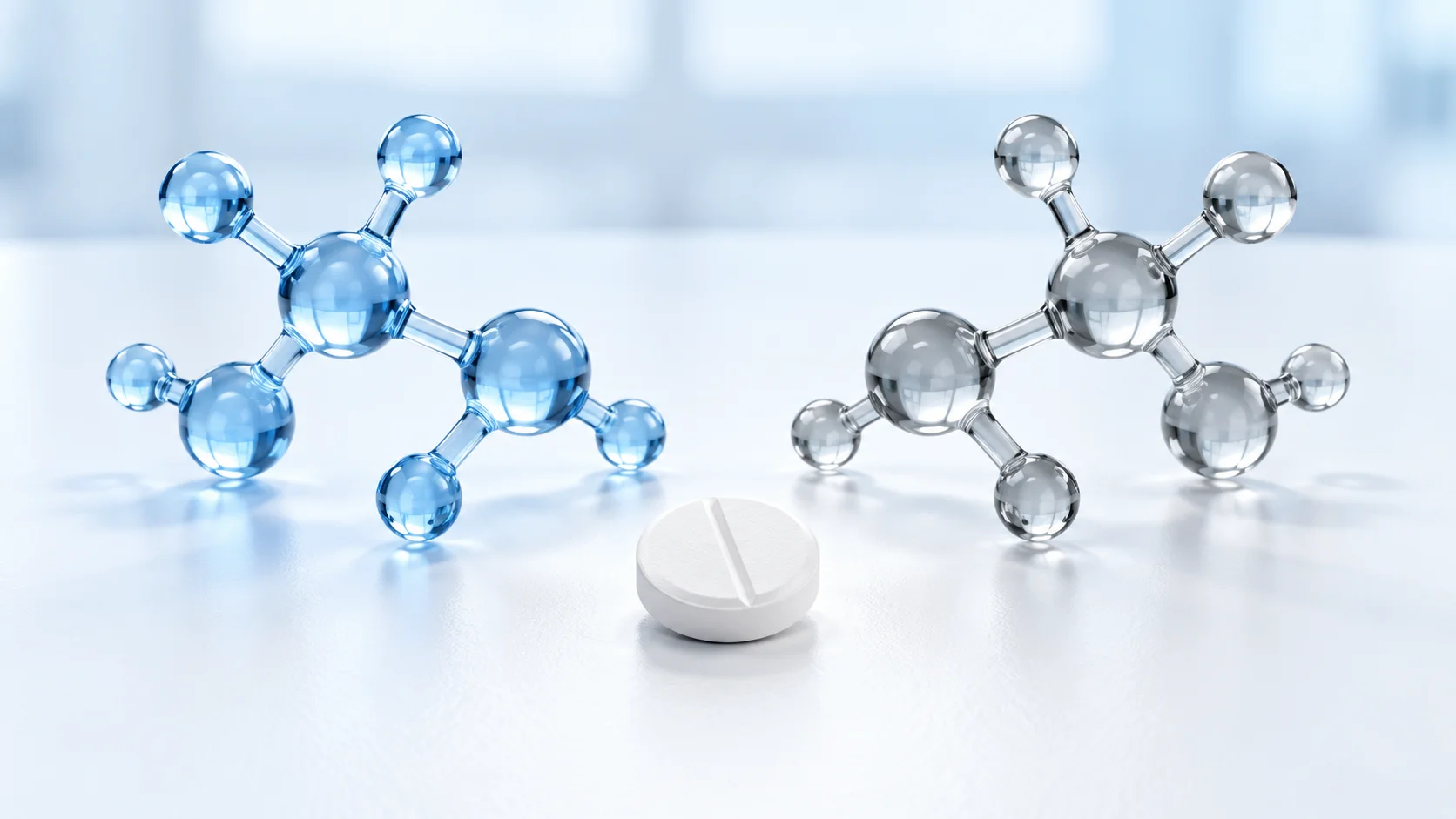
Enclomiphene is one half of Clomid. Clomiphene citrate, the drug sold as Clomid, is a mixture of two mirror-image molecules: enclomiphene (the trans-isomer) and zuclomiphene (the cis-isomer). The FDA label for Clomid states that the tablets contain "between 30% and 50% of the cis-isomer", which leaves roughly half to two thirds as enclomiphene.
The two halves behave differently. In the phase III paper by Kim and colleagues (BJU International, 2016), enclomiphene is described as having effects "consistent with oestrogen antagonism", while zuclomiphene "often acts as an agonist" and stays in the blood far longer. The trans-isomer was later developed on its own, under the name Androxal, to keep the part of clomiphene that raises testosterone and drop the part that lingers.
Men now search for it mainly for one reason: it can raise testosterone without shutting down sperm production, which is what happens on testosterone replacement. This guide covers how it works, what the clinical trials measured, how it compares with Clomid, and why it is still not an FDA-approved medicine. For the older drug it came from, see how Clomid works.
Enclomiphene is the trans-isomer of clomiphene. It has a half-life of about 10.5 hours, while zuclomiphene, the other half of Clomid, has a half-life of about 30 days (Wiehle et al., Fertility and Sterility, 2014).
How Enclomiphene Raises Testosterone
Testosterone in men is controlled by a feedback loop. The hypothalamus and pituitary gland read estrogen levels in the blood. When estrogen is high, they release less luteinizing hormone (LH) and follicle-stimulating hormone (FSH), and the testes make less testosterone and fewer sperm.
The drug blocks estrogen receptors at the hypothalamus and pituitary. The brain reads this as low estrogen and increases LH and FSH. LH tells the Leydig cells in the testes to make more testosterone; FSH supports sperm production. The testes do the work themselves, which is why doctors call this approach restoration rather than replacement.
The effect on hormones is measurable. In the phase IIB trial by Wiehle and colleagues (Fertility and Sterility, 2014), average LH rose from 4.4 to 8.9 mIU/mL on 12.5 mg daily and from 5.3 to 11.7 mIU/mL on 25 mg daily. FSH rose from 6.4 to 11.5 and from 9.4 to 14.9 mIU/mL. Men using testosterone gel in the same study saw both hormones fall.
This mechanism has a limit. It only works if the testes can respond to LH. The phase III trials enrolled men with low testosterone and LH below 9.4 IU/L, a pattern called secondary hypogonadism. Men whose testes are damaged (primary hypogonadism) already have high LH, and more LH does little for them. A blood test for LH and FSH before starting is what separates the two groups.
What the Clinical Trials Found
The drug went through phase II and phase III trials in the early 2010s. All of them compared it with testosterone gel, and most with placebo as well.
Enclomiphene trial results for total testosterone
Wiehle 2013, BJU Int
48 enrolled
6.25 to 25 mg, 6 weeks
604 on 25 mg vs 500 on gel at day 42
Kaminetsky 2013, J Sex Med
12
6 months
165 before, 525 on enclomiphene vs 545 on gel
Wiehle 2014, Fertil Steril
124 randomized
12.5 or 25 mg, 3 months
217 to 472 (12.5 mg), 210 to 406 (25 mg), placebo 214 to 199
Kim 2016, BJU Int (two phase III trials)
256 completed
12.5 or 25 mg, 16 weeks
203 to 446 and 213 to 413
Three results repeat across these studies. First, testosterone roughly doubled from a low starting point, landing in the normal range in most men. Second, the rise was fast: testosterone increased within 2 weeks in the phase II studies, and in phase III the level above 400 ng/dL was reached after 4 weeks. Third, the effect faded after stopping: in Kaminetsky's study, testosterone was back to its starting level one month after the last dose.
Newer data point the same way. A 2025 meta-analysis by Hohl and colleagues (Archives of Endocrinology and Metabolism) pooled 10 randomized trials with 819 men on clomiphene or enclomiphene and found testosterone about 274 ng/dL higher than placebo, with no significant difference from testosterone gel.
What the trials did not measure is just as relevant. They tracked blood levels, not how men felt. That gap is one reason regulators turned the drug down, covered below. Our enclomiphene results article adds what men report outside trials.
Fertility: The Main Difference From Testosterone Therapy
Testosterone therapy suppresses LH and FSH, and with them sperm production. This is well known in fertility clinics, and it is the reason enclomiphene was developed for younger men who want children.
The trials measured this directly. In the phase IIB trial, 54% of men on testosterone gel became oligospermic (sperm count below 15 million per mL), compared with 15 of 103 men (14.6%) at any point on enclomiphene. In the two phase III trials, sperm concentration rose by 11.7% and 15.2% on enclomiphene, and fell by 56.6% and 32.8% on AndroGel 1.62% over 16 weeks.
The small Kaminetsky study showed the same pattern: the drug raised sperm counts in 7 of 7 men at 3 months and 6 of 6 at 6 months, to 75 to 334 million per mL, while gel raised counts in only 2 of 5 men at 6 months.
For a man with low testosterone who plans to have children, this is the strongest argument for this approach over testosterone. For a man who does not care about fertility, the advantage is smaller, and testosterone therapy has decades more data behind it. The enclomiphene vs Clomid guide compares the two oral options side by side.
Enclomiphene vs Clomid in Brief
Because Clomid already contains the trans-isomer, the obvious question is why not just take Clomid. The answer lies in the other isomer.
Enclomiphene compared with clomiphene (Clomid)
Composition
Trans-isomer only
50 to 70% trans, 30 to 50% cis
Half-life
About 10.5 hours
Zuclomiphene about 30 days
Estrogen effect
Antagonist
Zuclomiphene partly agonist
FDA status
Not approved
Approved for ovulation in women
Zuclomiphene builds up. In a study by Helo and colleagues (BJU International, 2017), 15 men on long-term Clomid 25 mg daily had a median zuclomiphene level of 44.0 ng/mL against 2.2 ng/mL of the trans-isomer, a ratio of about 20 to 1.
A 2024 retrospective study by Saffati and colleagues (Translational Andrology and Urology) compared 66 men on one drug or the other. Side effects were reported by 47% of men on clomiphene and 13.8% on enclomiphene. Estradiol rose by 17.5 pg/mL on clomiphene and fell slightly on enclomiphene. Testosterone gains were not significantly different. It was a small, non-randomized study, so the numbers are a signal rather than proof. For the older drug's profile in men, see Clomid side effects in men.
Regulatory Status: Why Enclomiphene Is Not FDA Approved
The drug has been turned down by both major regulators. Repros Therapeutics filed it with the FDA as Androxal. On December 1, 2015, the company announced a Complete Response Letter stating that "the design of enclomiphene Phase 3 studies is no longer adequate to demonstrate clinical benefit" and asking for new phase 3 trials.
In Europe, the committee of the European Medicines Agency refused a marketing authorisation for EnCyzix (enclomifene) on 25 January 2018. The application rested on 4 studies with 588 men. The agency gave two reasons: the studies did not show whether symptoms such as libido or bone strength improved, and "there is a risk of venous thromboembolism". According to a 2026 position statement from the British Society for Sexual Medicine, development was stopped in 2021.
In the US, the product sold today comes from compounding pharmacies. In June 2022 an FDA advisory committee voted 8 to 4 against adding it to the list of bulk substances that pharmacies may compound. On the FDA list updated May 14, 2026, enclomiphene citrate sits in Category 1, "under evaluation". Compounded versions are not FDA approved and are not checked by the FDA for safety or quality. Our guide to enclomiphene prescription and cost covers how men get it and what it costs.
For athletes, clomifene is on the 2026 WADA Prohibited List under anti-estrogenic substances and is banned at all times. The trans-isomer is not named separately, but the class wording covers it.
Who Considers Enclomiphene and Where the Evidence Stops
The trials support a narrow picture. The men studied were mostly overweight, aged 18 to 60, with total testosterone under 300 ng/dL and low or normal LH. In that group, 12.5 to 25 mg a day raised testosterone into the normal range within a month and kept sperm production intact.
Outside that group, evidence is thin. There are no long-term trials beyond a few months, no trials in men with primary hypogonadism, and no approved product with a fixed quality standard. Side effects in phase III were reported by 21% of men as possibly related to the drug, none serious; the enclomiphene side effects guide lists them. Dose questions are covered in the enclomiphene dosage guide.
Anyone considering it needs baseline blood work (total testosterone, LH, FSH, estradiol), a doctor who can read the results, and repeat labs after about 4 weeks, which matches the point at which trial levels settled.
Frequently Asked Questions
Enclomiphene is the trans-isomer of clomiphene citrate, the drug in Clomid. It blocks estrogen receptors in the hypothalamus and pituitary, which raises LH and FSH and makes the testes produce more testosterone. It was developed as Androxal for men with secondary hypogonadism but is not FDA approved.
No. Clomid is a mix of two isomers, with 30 to 50% zuclomiphene according to its FDA label. Enclomiphene is the single trans-isomer. Its half-life is about 10.5 hours, while zuclomiphene lasts about 30 days and builds up with daily use.
In the phase III trials published in 2016, average testosterone rose from about 203 to 446 ng/dL and from 213 to 413 ng/dL over 16 weeks. In the phase IIB trial, 12.5 mg daily took men from 217 to 472 ng/dL in 3 months, while placebo stayed near 200.
In trials it preserved sperm production. Sperm concentration rose 11.7% and 15.2% over 16 weeks, while it fell 56.6% and 32.8% on testosterone gel. In another trial 54% of men on gel became oligospermic compared with 14.6% on the oral drug.
No. The FDA issued a Complete Response Letter in December 2015 asking for new trials, and the EMA refused approval in 2018, citing unproven symptom benefit and a risk of blood clots. Products sold in the US today are compounded and not FDA approved.
No. It is a selective estrogen receptor modulator, not an anabolic steroid or a hormone. It does not add testosterone to the body. It signals the brain to release more LH and FSH, and the testes then make more of their own testosterone. It falls under WADA's banned anti-estrogen class.
Clomid.org is an independent educational resource. We are not affiliated with any pharmaceutical manufacturer, compounding pharmacy, telehealth company or healthcare provider. This content is for informational purposes only and does not constitute medical advice. Images on this site are illustrative artwork made for editorial purposes; they do not show real products, packaging or labels and are not an advertisement or an offer to sell.
Editorial
Author
Comments (0)
Be the first to comment on this article.